


Quick Answer: Synonyms for They
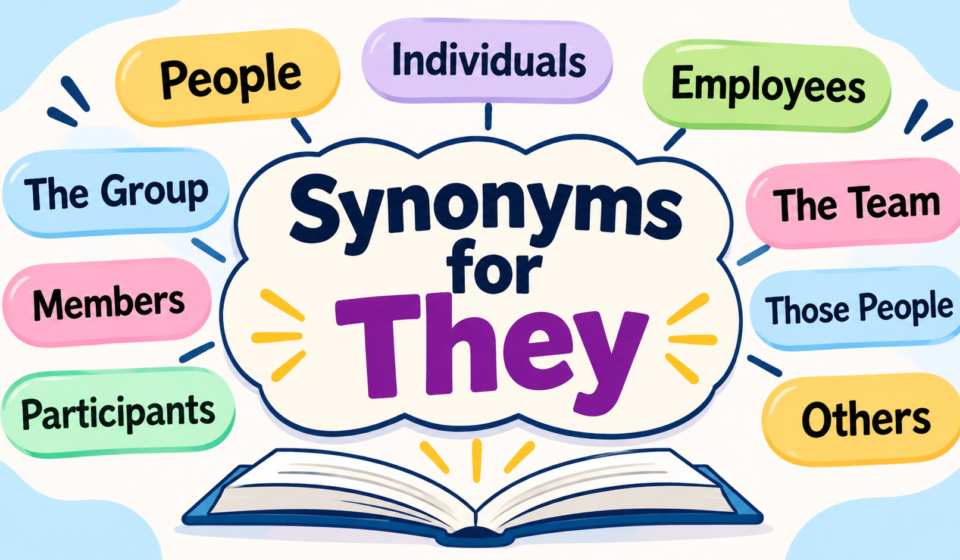
You can use words and phrases such as people, individuals, others, members, team members, employees, participants, and those involved instead of they in certain sentences.
The best choice depends on the context. For example, use “employees” when discussing workers and “participants” when referring to people taking part in an activity.
Remember that these are not direct replacements in every sentence. You may need to rewrite the sentence to keep its grammar correct.
Pronunciation and Word Details
A few basic language facts can help you understand this pronoun better.
- Word: They
- Pronunciation: /ðeɪ/
- How to say it: Thay
- Part of speech: Personal pronoun
- Word type: Third-person pronoun
- Related forms: Them, their, theirs, themselves
30+ Words and Phrases You Can Use Instead of They
There is no single word that can replace they in every sentence. However, you can use different words and phrases depending on the people or group you are talking about.
1. People
Meaning: Human beings in general.
Example: People enjoy spending time with friends.
2. Individuals
Meaning: Separate or specific people.
Example: Individuals have different opinions.
3. Those People
Meaning: A particular group of people.
Example: Those people are waiting outside.
4. These People
Meaning: People who are nearby or recently mentioned.
Example: These people work very hard.
5. The Group
Meaning: A collection of people.
Example: The group is ready for the meeting.
6. The Team
Meaning: People working together.
Example: The team has completed the project.
7. Team Members
Meaning: People who belong to a team.
Example: Team members are sharing their ideas.
8. The Staff
Meaning: People working for an organization.
Example: The staff is preparing the office.
9. Employees
Meaning: People who work for a company.
Example: Employees are attending the training.
10. Workers
Meaning: People who do a job.
Example: Workers are improving their skills.
11. Customers
Meaning: People who buy products or services.
Example: Customers are asking for more options.
12. Guests
Meaning: People invited to an event or place.
Example: Guests are enjoying the party.
13. Members
Meaning: People belonging to a group.
Example: Members are voting on the new plan.
14. Participants
Meaning: People taking part in an activity.
Example: Participants are learning new skills.
15. Students
Meaning: People who study at a school or college.
Example: Students are preparing for exams.
16. Children
Meaning: Young people.
Example: Children are playing in the garden.
17. The Family
Meaning: People related to one another.
Example: The family is planning a trip.
18. The Audience
Meaning: People watching or listening to something.
Example: The audience is enjoying the show.
19. The Committee
Meaning: People chosen to make decisions.
Example: The committee has approved the plan.
20. The Company
Meaning: A business or organization.
Example: The company is launching a new product.
21. The Organization
Meaning: A group formed for a purpose.
Example: The organization supports local communities.
22. Those Involved
Meaning: People taking part in a situation.
Example: Those involved are discussing the issue.
23. Others
Meaning: Additional people.
Example: Others are waiting for their turn.
24. Each Person
Meaning: Every individual in a group.
Example: Each person has a different opinion.
25. Someone
Meaning: An unknown or unspecified person.
Example: Someone is waiting at the door.
26. This Person
Meaning: A particular person being discussed.
Example: This person has valuable experience.
27. That Person
Meaning: A person already mentioned or identified.
Example: That person knows the answer.
28. The People Involved
Meaning: People connected to a situation.
Example: The people involved are working together.
29. The Residents
Meaning: People living in a particular place.
Example: The residents are attending the meeting.
30. The Community
Meaning: People living in the same area or sharing an interest.
Example: The community is working toward a common goal.
How Is They Used in English Grammar?
Before replacing a pronoun, it helps to understand how it works in a sentence.
They is a personal pronoun. It usually refers to two or more people or things. It can also refer to one person when their gender is unknown, irrelevant, or when that person uses they/them pronouns.
Here are its main grammatical uses:
- Subject pronoun: They are waiting outside.
- Object pronoun: I invited them to the meeting.
- Possessive determiner: Their house is nearby.
- Possessive pronoun: The decision was theirs.
- Reflexive pronoun: They completed the task themselves.
Singular They vs. Plural They
The pronoun they has both singular and plural uses.
Plural they refers to more than one person or thing.
Example: They are playing football.
Singular they refers to one person. It is commonly used when the person’s gender is unknown or when someone uses they/them pronouns.
Example: Someone left their phone. They may come back for it.
How to Replace They Without Changing the Meaning
Not every alternative works in every situation. The goal is to make your sentence clearer without changing who or what you are talking about.
Consider these examples:
Original: They completed the assignment.
Alternative: The students completed the assignment.
This works if “they” refers to students.
Original: They attended the meeting.
Alternative: The team members attended the meeting.
This works if the people at the meeting belong to the same team.
Original: They helped the customers.
Alternative: The employees helped the customers.
This works if “they” refers to employees.
Common Mistakes to Avoid
When using alternatives to they, keep these points in mind:
- Do not replace it with an unrelated group: Use “employees” only when the sentence refers to workers.
- Check subject and verb agreement: “The team is ready” and “Team members are ready” use different verb forms.
- Do not confuse related pronouns: They, them, their, and theirs have different grammatical roles.
- Avoid unnecessary repetition: Repeating a noun in every sentence can make writing sound unnatural.
- Respect a person’s pronouns: If someone uses they/them pronouns, do not replace them with another pronoun that misrepresents that person.
Which Alternative Should You Choose?
The right word depends on your writing purpose.
- For everyday writing: People, others, and individuals can work well.
- For business writing: Employees, staff members, and team members are often more precise.
- For academic writing: Students, researchers, and participants may fit better.
- For community topics: Residents, members, and the community can be useful.
- For a specific situation: The people involved or those concerned may provide more detail.
Frequently Asked Questions
What is the best synonym for they?
There is no single best synonym for they. Words such as people, individuals, members, and others can work in different situations.
Can I use people instead of they?
Yes, but you may need to rewrite the sentence. For example, “They are waiting” can become “The people are waiting.”
Is they singular or plural?
They can be both singular and plural. It refers to multiple people or things in plural use and one person in singular use.
Is they a noun or pronoun?
They is a personal pronoun. It replaces a noun or noun phrase in a sentence.
What are the other forms of they?
The related forms include them, their, theirs, and themselves. Each form has a different grammatical purpose.
Does they have an opposite word?
They does not have a direct opposite or standard antonym. Its meaning depends on the people or things being discussed.
Final Thoughts
Finding the right alternative to they can make your writing clearer and more specific. Synonyms for They include words and phrases like people, individuals, employees, members, and participants. These alternatives are useful when they accurately describe the group or person in question.
However, these alternatives are not interchangeable in every sentence. Pay attention to grammar and context before making a change. When “they” is already clear and natural, there is no need to replace it.


[…] READ MORE: Synonyms for They: 25+ Better Ways to Express the Same Idea ❯ […]