

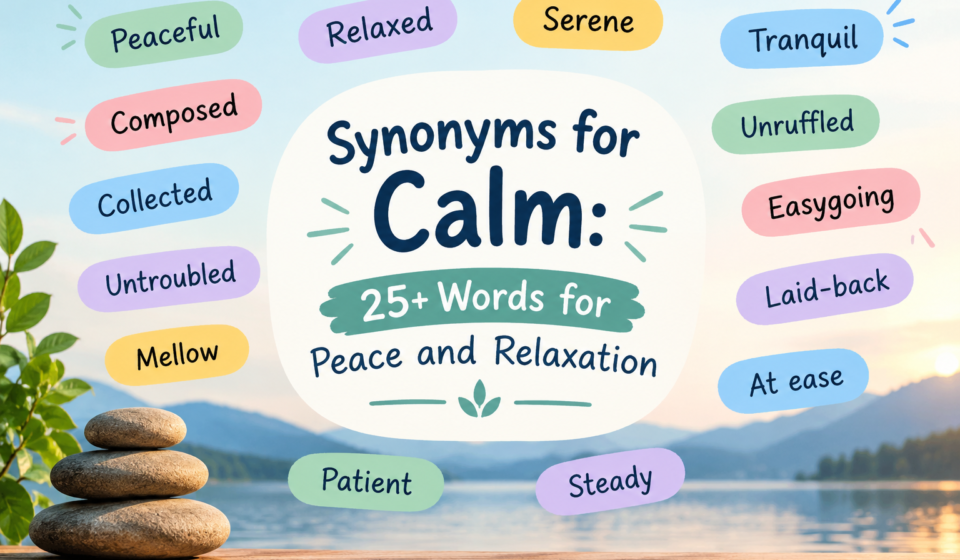

Calm means feeling peaceful, relaxed, or free from worry. Words such as peaceful, composed, serene, tranquil, and untroubled can express different kinds of calmness. The best choice depends on whether you are describing a person, a place, a feeling, or a difficult situation.
What Does Calm Mean?
The word calm describes a state without strong worry, anger, excitement, or disturbance. It can refer to a person’s feelings, behavior, voice, or surroundings.
For example, a calm person can handle stress without losing control. A calm room feels quiet and relaxing, while a calm mind is free from unnecessary worry.
The word can also work as a verb. To calm someone means to help them feel less upset or nervous.
Examples:
- She stayed calm during the interview.
- The lake looked calm in the early morning.
- His kind words helped calm the frightened child.
What Are the Best Synonyms for Calm?
The best alternatives depend on the situation. Some describe inner peace, while others focus on self-control or a quiet environment.
Here are ten useful choices:
- Peaceful: Free from trouble, stress, or disturbance.
- Relaxed: Comfortable and free from tension.
- Serene: Deeply peaceful and undisturbed.
- Tranquil: Quiet and restful.
- Composed: In control of your emotions.
- Collected: Able to think clearly under pressure.
- Untroubled: Not worried or upset.
- Placid: Calm and not easily disturbed.
- Mellow: Gentle, easygoing, and relaxed.
- Unruffled: Not upset by problems or unexpected events.
25 Synonyms for Calm With Meanings and Examples
The following words offer different ways to describe calm feelings, behavior, and surroundings. Some are close substitutes, while others work best in specific situations.
| Synonym | Meaning | Example |
| Peaceful | Free from worry or disturbance | She felt peaceful after her walk. |
| Relaxed | Free from physical or mental tension | He looked relaxed after his vacation. |
| Serene | Deeply peaceful and untroubled | Her serene expression made everyone feel welcome. |
| Tranquil | Quiet and restful | We spent the afternoon beside a tranquil lake. |
| Composed | In control of your emotions | She remained composed during the meeting. |
| Collected | Able to think clearly under pressure | He stayed collected when the plans changed. |
| Untroubled | Not worried or upset | She seemed untroubled by the delay. |
| Placid | Calm and not easily disturbed | The placid dog rested near the door. |
| Mellow | Gentle, easygoing, and relaxed | He has a mellow personality. |
| Unruffled | Not upset by difficulties | She remained unruffled by the criticism. |
| At ease | Comfortable and relaxed | I felt at ease talking to my teacher. |
| Restful | Helping someone relax | The room had a restful atmosphere. |
| Still | Not moving or making noise | The water was still before sunrise. |
| Quiet | Making little or no noise | We found a quiet corner to read. |
| Gentle | Soft, kind, or mild | He spoke in a gentle voice. |
| Mild | Not strong, harsh, or severe | She gave a mild response to the complaint. |
| Steady | Firm and controlled | He kept a steady voice during the speech. |
| Level-headed | Able to think sensibly under stress | We need a level-headed person to solve this problem. |
| Self-possessed | Confident and emotionally controlled | She appeared self-possessed in front of the audience. |
| Unflustered | Not confused or upset | The teacher stayed unflustered during the interruption. |
| Equable | Even-tempered and steady | His equable nature made him easy to work with. |
| Imperturbable | Not easily disturbed or upset | The experienced pilot remained imperturbable. |
| Unemotional | Showing little outward emotion | He gave an unemotional answer to the question. |
| Balanced | Emotionally steady and sensible | She took a balanced approach to the disagreement. |
| Patient | Able to wait without becoming annoyed | He was patient with the new employee. |
| Tolerant | Willing to accept differences or delays | She remained tolerant during the discussion. |
| Laid-back | Relaxed and easygoing | My brother is laid-back about small problems. |
| Easygoing | Not easily worried or annoyed | Our easygoing host made everyone comfortable. |
| Unhurried | Not rushed or hurried | We enjoyed an unhurried breakfast. |
| Unconcerned | Not appearing worried | He seemed unconcerned about the minor mistake. |
| Peaceable | Inclined to avoid conflict | They reached a peaceable agreement. |
| Undisturbed | Not interrupted or affected | She enjoyed an undisturbed hour of reading. |
| Sedate | Quiet, controlled, and not rushed | The gathering had a sedate atmosphere. |
| Cool-headed | Able to stay sensible in a stressful moment | A cool-headed manager can make better decisions. |
| Self-controlled | Able to manage feelings and actions | He remained self-controlled during the argument. |
Which Word for Calm Fits Your Situation?
The most useful alternative depends on what you want to describe. Use these groups to find the right fit.
For a Peaceful Mind
Choose these words when someone feels free from worry or emotional pressure:
- Peaceful: A general feeling of peace.
- Serene: A deeper sense of inner peace.
- Untroubled: Free from worry about a particular issue.
- At ease: Comfortable in a situation.
- Relaxed: Free from tension or stress.
Example: “After finishing her exams, Maya felt relaxed and at ease.”
For Someone Who Stays Calm Under Pressure
These words describe people who handle stress without losing control:
- Composed: Emotionally controlled.
- Collected: Able to think clearly.
- Level-headed: Sensible when problems arise.
- Cool-headed: Calm and practical in a stressful moment.
- Unflustered: Not confused or upset by unexpected events.
- Self-possessed: Confident and in control of one’s behavior.
Example: “The level-headed team leader helped everyone focus on the solution.”
For a Quiet Place or Setting
Use these alternatives to describe a peaceful environment:
- Tranquil: Quiet and restful.
- Still: Without movement or noise.
- Quiet: Having little sound or activity.
- Restful: Encouraging relaxation.
- Serene: Peaceful and beautiful in an undisturbed way.
- Undisturbed: Free from interruptions.
Example: “We spent the evening in a tranquil garden away from traffic.”
For a Gentle or Relaxed Personality
These words describe people who are easy to approach and not easily annoyed:
- Easygoing: Relaxed and flexible.
- Laid-back: Not easily bothered by small things.
- Mellow: Gentle and relaxed.
- Mild: Not harsh or aggressive.
- Placid: Usually calm and not easily excited.
- Patient: Able to wait or deal with difficulties without frustration.
Example: “Her easygoing nature makes her a good person to work with.”
Calm vs. Peaceful vs. Serene: What Is the Difference?
These three words are closely related, but each has a slightly different meaning.
| Word | Main Meaning | Example |
| Calm | Free from strong emotions or disturbance | He stayed calm during the emergency. |
| Peaceful | Free from conflict, trouble, or worry | The family enjoyed a peaceful evening. |
| Serene | Deeply quiet, peaceful, and undisturbed | The mountains looked serene at dawn. |
Calm is the most flexible of the three. You can use it for a person, voice, sea, or situation.
Peaceful often suggests the absence of conflict or worry. It works well when describing a home, community, feeling, or moment.
Serene creates a stronger sense of quiet beauty or deep inner peace. It is especially useful in descriptive writing.
For example, a person may remain calm during a difficult meeting, feel peaceful after resolving a problem, and enjoy a serene morning in the countryside.
How Can You Describe Someone Who Stays Calm Under Pressure?
Sometimes one word is not enough. A short expression can describe a person’s behavior more naturally.
- Keeps a cool head: Thinks clearly during a difficult situation.
- Remains composed: Controls emotions when things become stressful.
- Does not lose their temper: Avoids becoming angry.
- Takes things in stride: Handles problems without becoming overly upset.
- Keeps their feet on the ground: Remains sensible and realistic.
- Maintains a level head: Makes sensible decisions under pressure.
Examples:
- Instead of “She is calm during emergencies,” write, “She keeps a cool head during emergencies.”
- Instead of “He stayed calm after the criticism,” write, “He took the criticism in stride.”
- Instead of “The manager was calm during the disagreement,” write, “The manager remained composed during the disagreement.”
These expressions work well in everyday conversations, workplace communication, and personal descriptions. Choose one that matches the person’s actual behavior rather than simply choosing the most impressive-sounding phrase.
What Are the Opposite Words of Calm?
Words with the opposite meaning of calm can describe stress, worry, anger, or a lack of control.
- Anxious
- Agitated
- Nervous
- Worried
- Upset
- Restless
- Tense
- Frantic
- Panicked
- Flustered
- Irritated
- Angry
- Disturbed
- Troubled
- Uneasy
- Stressed
- Turbulent
- Chaotic
- Excited
- Overwhelmed
Not every word is an exact opposite in every situation. For example, chaotic usually describes a disorganized environment, while anxious describes a person’s feelings. Choose an antonym that matches the meaning you want to express.
How Can You Use Calm in Better Writing?
Using the same word too often can make a paragraph sound repetitive. The solution is not to replace every instance of calm, but to select a more precise word when it adds meaning.
1. Match the Word to the Situation
Use composed when describing emotional control, tranquil for a peaceful setting, and relaxed for a person who feels comfortable.
Before: She was calm during the meeting.
After: She remained composed during the meeting.
The second sentence gives a clearer idea of how she behaved.
2. Choose Simple Words for Everyday Writing
Words such as quiet, peaceful, relaxed, and patient are easy to understand. They usually work well in emails, school assignments, and everyday conversations.
You do not need a complicated word when a familiar one explains your point clearly.
3. Use Descriptive Words for the Right Effect
In creative writing, words like serene and tranquil can help readers picture a peaceful scene.
Example: “The tranquil lake reflected the soft morning light.”
Here, tranquil describes more than a lack of noise. It creates a restful mood.
4. Avoid Replacing Every Repeated Word
Repeating a word is not always a problem. If you are writing about a calm person, using calm more than once may be clearer than adding unusual alternatives.
Good writing focuses on meaning first. Variety is helpful only when it improves the sentence.
Frequently Asked Questions
What is the closest synonym for calm?
Peaceful and relaxed are two of the closest everyday alternatives. Peaceful emphasizes freedom from disturbance, while relaxed emphasizes being free from tension.
What is a stronger word for calm?
Serene can suggest deep peace, while imperturbable describes someone who is extremely difficult to upset. The best choice depends on whether you are describing a feeling or a person’s behavior.
What is another word for a calm person?
You can describe a calm person as composed, collected, level-headed, easygoing, or cool-headed. Use composed for emotional control and easygoing for a relaxed personality.
What is a word for feeling calm and relaxed?
At ease is a natural expression for feeling comfortable and free from worry. Relaxed, peaceful, and untroubled are also useful choices.
What is a formal synonym for calm?
Composed, collected, and self-possessed are suitable in many formal situations. For example, “The speaker remained composed throughout the presentation.”
What is the difference between calm and tranquil?
Calm is a broad word for a person, feeling, situation, or place without disturbance. Tranquil more strongly suggests a quiet, peaceful, and restful environment or state.
What is the opposite of calm?
Common opposites include agitated, anxious, nervous, restless, tense, and frantic. The best antonym depends on whether you mean emotional stress, anger, or disorder.
Conclusion
There are many ways to describe calmness, from simple words like peaceful and relaxed to more specific choices like composed, level-headed, and tranquil. Each alternative adds a slightly different meaning.
When choosing among these synonyms, think about what you are describing. Use composed for emotional control, relaxed for comfort, and serene for deep peace. The right word makes your writing more natural, precise, and engaging.


